I always like to stretch in my clone builds. The decal draw was a big chore, but in the end worth the effort.
Tuesday, September 29, 2020
Estes Colonial Viper #1310, Finished
I always like to stretch in my clone builds. The decal draw was a big chore, but in the end worth the effort.
Monday, September 28, 2020
Estes Colonial Viper #1310, Part 15, Gloss? Paint & Decals
I did spray gloss white paint, but with the Florida humidity, most all surfaces came up as a flat finish.
TIP: You can improve the gloss of a flat "humidity" finish with careful use of automotive polishing compound. Use polishing compound - rubbing compound would bee too rough.
Watch your fingernails! They can easily scratch the balsa surfaces. The picture shows the lower half of the upper fin after polishing with some rubbing compound. It's not a full shiny gloss, but enough shine I can accept.
The decals are now available to Patreon supporters as a PDF for home printing. You could print these on self adhesive paper (stickers, like in the original kit) or on water slide decal paper.
Email me at: oddlrockets@bellsouth.net and ask for the Colonial Viper PDF Decals. This decal draw is not an exact copy of the Estes kit decals.
Here's the back end with all the engine decals in place.Notice the red bars set on the tubes extend and line up with the fin decals. I did go back to the decal draw and make the widths consistent between the pieced decals.
TIP: Set the engine wrap decals first, then match up the red line on the wing decals.
The long red stripe continues down the top of the main body tube and over the nose cone.
This requires a close cut with no clear area over the tube edge and in the nose cone shoulder.
TIP: This is one of the few areas where I use Future clear coat. I only use it to seal the cut edges with a light wipe using a Q-tip.
Sunday, September 27, 2020
Estes Colonial Viper #1310, Part 14, Canopy Forming
You will need to emboss the dashed folding lines. I still like using the tip of a dull butter knife and a straightedge.
The folds should be sharp and straight.
I used my long, straight tweezers and set the side right down the fold line.
My burnisher was run over the dashed line while the tweezers held the dashed line straight.
Shape the canopy making the longer sides as straight as possible. The sides will want to curve out.
Glue the balsa post piece down the center.Saturday, September 26, 2020
Estes Colonial Viper #1310, Part 13, Laser Cannons, Launch Lug & Trim
Wrap some 400 grit around the large 3/16" diameter end and sand a concave dip into the edge.
The picture on the right shows a dry test fit.
The cannon assembly should end up even with the back end of the extension piece. Note the line of glue on the 3/16" rear lug.
View from the back to double check the orientation off the assembly.
The instructions have you glue the launch lug 3" up from the rear end of the model. This may have something to do with the C/G considering the 1/2 oz. of clay in the nose.
I glued my launch lug so it will be covered by the long rectangle piece. Look close and you can find it in the picture.
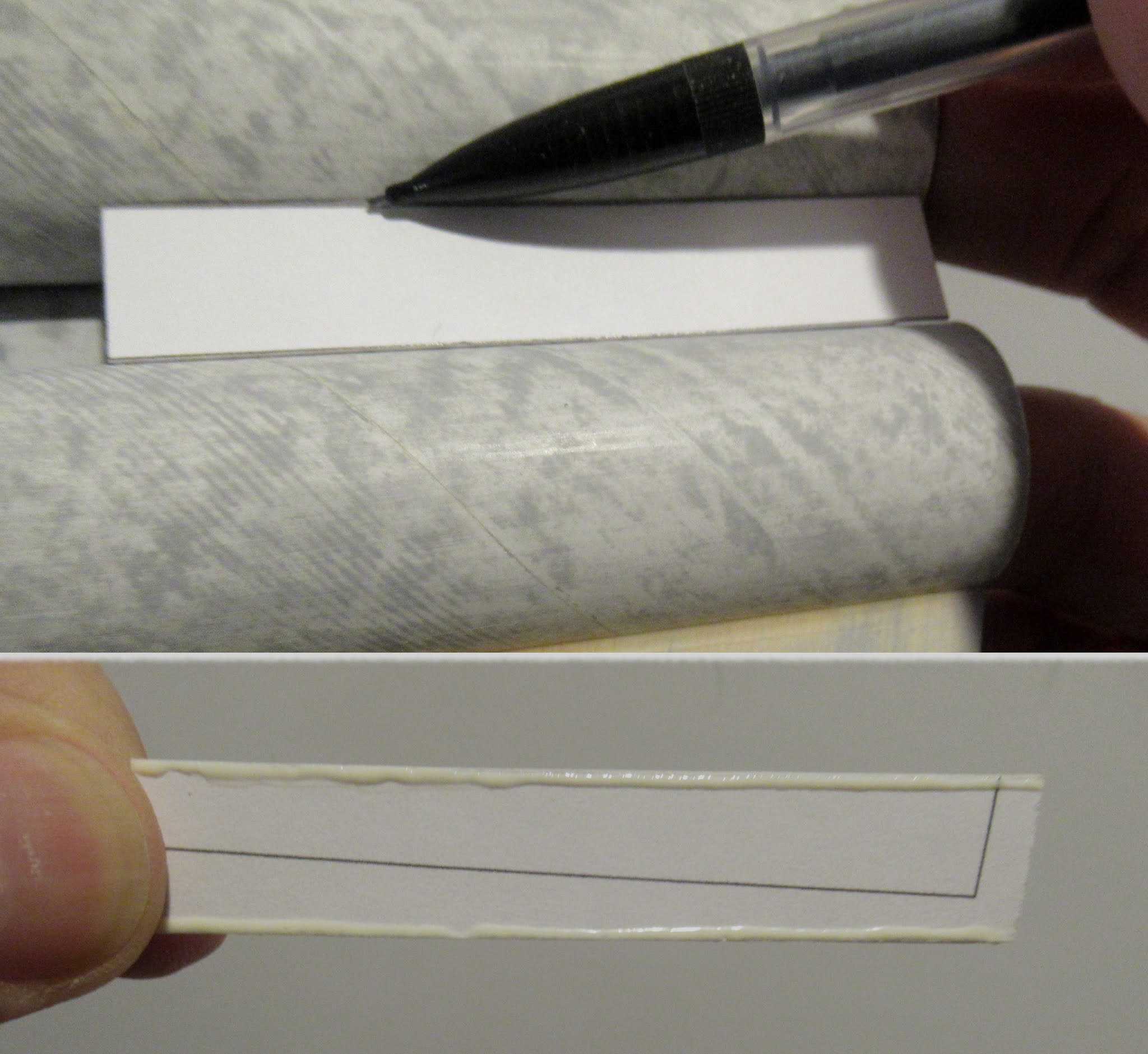
It took a few tires to get the card stock piece in the correct position and angle. Once it was set down dry, pencil lines were traced on the outside edges.
I use very little glue along the edges for initial bonding. Fillets were added after this dried. That thin line on the inside laminate was left over from a earlier 110 lb. stock print. It'll be inside and not seen.
Here's the card stock rectangle glued in place with the launch lug hidden underneath.
Friday, September 25, 2020
Estes Colonial Viper #1310, Part 12, Fin Gluing
I set a line of glue down the root edge of the fins and set them on the pencil line - then slid the alignment guide on over the fins.
Thursday, September 24, 2020
Estes Colonial Viper #1310, Part 11, Tube Fillets
Mentioned earlier, the instructions have you set a line of glue down the top engine tube. Slide the glued tube through the alignment guide, then turn the tube and line of glue to make contact with the interior tube.
I used very little glue to adhere the outside BT-52 tube, deciding to make fillets only on the top side in the area that will be covered by the card stock rectangular strips.
Why not fillet on all sides? Fillets in deep, tight corners are difficult to get smooth. You always end up with bubbles.
Here's the bottom of the model.
I'm not doing fillets here in the tube joints, just on the top where they will be covered by the card stock strips.
Wednesday, September 23, 2020
Estes Colonial Viper #1310, Part 10, Gluing Together The Four Tubes
Tuesday, September 22, 2020
Estes Colonial Viper #1310, Part 9, Tube Prepping
In the right side picture, the BT-50 H slides right into the BT-52.
I ordered the BT-52 tube from Balsa Machining Service. Instead of shipping in a long box (the tubes are 24" long!) I told Bill he could cut the tube into smaller segments, send in a smaller box and save on shipping costs. Bill asked if he could rough cut the tube using a band saw. I said: "Sure!"
Monday, September 21, 2020
Estes Colonial Viper #1310, Part 8, Decal & Template Drawing
I spent more time redrawing these decals than any other project to date. There's a lot of detail in the engine wraps.
The decals are now available to Patreon supporters as a PDF for home printing.
Email me at oddlrockets@bellsouth.net and ask for the Colonial Viper Decal PDF.
This is not an exact copy of the Estes kit decals. I made a few subtle changes so I could identify them. These decals are for Single Builds Only - Not for sale or to be used in commercial kit production.
The picture posted above right is the second of three revised decal draws. After the decals were placed on the model, a third edit followed to better fit the assembled parts.
At the bottom of the fin template is the rudder piece. In the old Estes kit, the balsa grain ran parallel to the root edge, not the leading edge. I drew the rudder fin with the stronger grain orientation.
The alignment guides were also drawn.
Print on 110 lb. card stock and back with a second piece of card stock before cutting out.
Sunday, September 20, 2020
Estes Colonial Viper #1310, Part 7, Laser Cannons
The laser cannons are made up of a 1" long 3/16" launch lug, a 1 3/16" long 1/8" lug and a 1" length of 1/8" dowel.
On the bottom of the picture is a glued-up finished laser cannon.
Draw a line down the dowels and lugs. It's not easy to keep them in line during gluing.
Use the pencil lines to get everything straight.
Mark the depth for the 3/16" lug on the 1/8" lug.
Match up the center lines and the three pieces should end up in a straight line.
Here's the two finished laser cannons.
Saturday, September 19, 2020
Estes Colonial Viper #1310, Part 6, Wing Cutting & Gluing
The wing fins are three pieces. Note the grain on the two mirrored pieces.
The wing extension pieces is glued into the notch in the front piece.
I didn't glue the extension piece in yet, I wanted to sand the root edges flat without the extension piece in the way.
Setting the wing on the flat sanding block shows the bottom root edge wasn't flat. Now the root edge is trued up.
The the extension is glued in place.
Notice the pencil line in the instruction picture above. The bottom of the extension piece should be parallel to the root edge of the fin.
The wing and rudder pieces got a coat of CWF.
The picture on the left shows some balsa warping when only one side has the water based CWF coat. Don't panic - Painting the other side will straighten it things out after the filler dries.
Friday, September 18, 2020
Estes Colonial Viper #1310, Part 5, Clay Weight & NC Shoulder Fit
The cut plug was slid into the nose cone shoulder base.
To seal the end before pressing in the oily clay, the card stock disk got a coat of wood glue applied with a Q-tip. Let dry before adding the clay.
I weighed out the equivalent amount of clay.
On the right, the nose cone was slid into the BT-50 H tube.
These nose cone molds were originally made for Starlight Rockets and are now owned by Apogee. They fit the heavy walled tubes very well, but there is a light overlap at the shoulder base.
This was sanded down with 220 grit on a block, followed by smooth sanding with 400 grit.