Monday, December 18, 2023

Estes Great Goblin, #9724 Build, Part 4, Two Piece Fins


It is suggested that you sand both sides of the balsa sheets before removing from the sheets.
I don't see why it's necessary. Years ago, sanding die-cut balsa might help free up a fin that wasn't cut all the way through the sheet.
Now, a laser cuts all the way through.

You'll sand the flat sides when sanding off the filler.

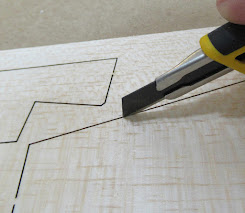
All you need is a knife blade to free the fins, cutting through the hold-down tics.
Never punch out laser cut fins without cutting through the tabs. I use a break-off blade to remove the fins. I save the more expensive X-Acto #11 blades for more delicate cuts.
As mentioned many times before,
Laser cuts diffuse and widen when burning through the balsa. 
The bottom side of a laser cut is wider than the top. You can see line widths by flipping over a fin sheet. The laser cut is a wedge cut.   

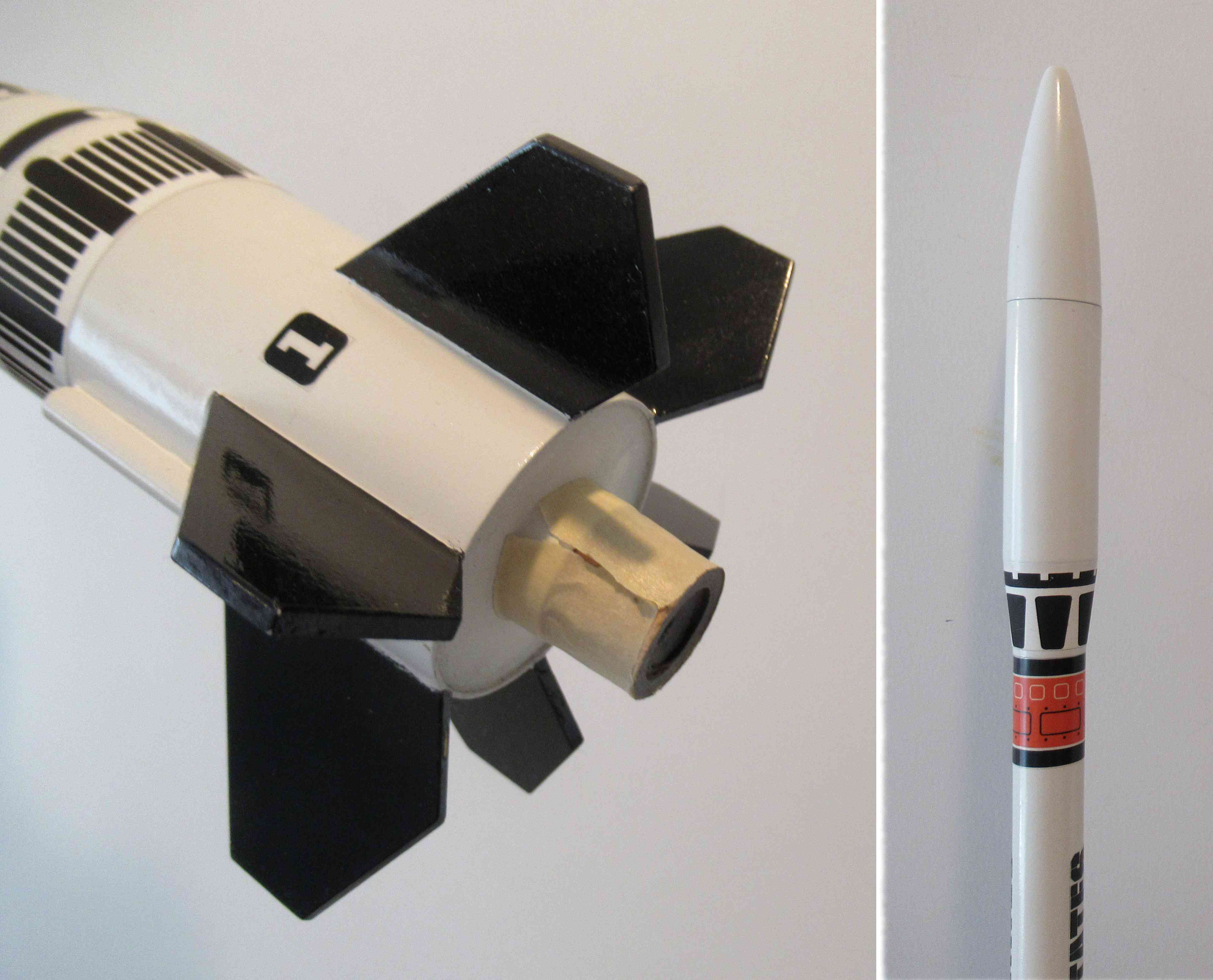
On the left is a before and after sanding of the slightly angled sides. The butt joint (right side) after sanding is much better.
More in the next post . . .

Sunday, December 17, 2023

Estes Great Goblin, #9724 Build, Part 3, Parts


All the parts:
The big nose cone, 12 3/8" exposed above the shoulder
29mm screw on Motor Retainer
Two 1/4" diameter x 1" long launch lugs
24" Nylon Parachute
8" long motor mount tube 
Cardstock Centering Rings
Rubber Shock Cord, 1/4" x 45" long
Four sheets laser cut hard balsa, 1/8" thick
3" diameter x 20 3/8" long heavy wall tube
Not shown: Tri-Fold shock cord mount


Black print, water slide decals! 
I'll be spending some extra time showing how to glue up and hide the seam in the two piece fins.

Friday, December 15, 2023

Estes Great Goblin, #9724 Build, Part 2, Box & Past Builds


Here's the box!


And, the box sides.

Yep, there's more than one. I'll be building two show models and one flight model for Estes.

This ain't my first Goblin build -
On the left is the Semroc Goblin, BT-55, original size.

The large Goblin was one of the first builds I did when I got back into the hobby in 2009. Its very heavy, has never flown. Heavy wall 2.35" diameter tube, basswood fins, plywood baffle and probably the longest balsa nose cone I've ever used.

TRIVIA: Notice the "3" decals are flipped on their sides (like a stylized bat) and the other decal baselines are parallel to the floor. These decals were set as shown in the original instructions.
 
I can hear the readers: 
"Enough already, get on with the build!"

Thursday, December 14, 2023

Estes Great Goblin, #9724 Build, Part 1, Background

 
Introduced in 1970 in a sales flyer included with V10, #2 of the Model Rocket News.
The original Estes BT-55 based Goblin was a "FREE" or Bonus kit. If your order totaled a certain amount, you could pick out a listed (free) kit at no extra charge.
It became a regular catalog model in 1972 and retailed for $2.50.

The Goblin kit was catalog number K-55, later designated number 1255.
Designed by Wayne Kellner.

The Goblin design was made for the new D13 motors. The D13 motors were slightly downgraded in power after many CATOs to the D12 you have now. I had a few "blow-through" fireballs using the first D13 engines.

At first, the 24mm D13-5 was a recommended engine. Later catalog listings recommended the D12-7. You could fly the Goblin using 18mm engines with a 20/50 adapter.


I did a build of the BT-55 Semroc clone kit a few years back. 
To see that build, CLICK HERE 

Here's the parts from a later Estes kit. The original 1970s version didn't include clay nose weight.

Tuesday, December 5, 2023

Orlando R.O.C.K. Launch, December 2, 2023


After a few cold days, weather was warm but bearable. Winds were low, maybe 5 mph.

First up for me was the BT-55 based clone of the old ARAPAHO kit. Mine takes 18mm motors, today a B6-4.

Do you think the shock cord is long enough?


Roger and Bracha Smith's dog Buddy enjoyed chewing up the styrofoam ball in a bagged Sputnik kit. He actually chewed it at the JonRocket store. Roger brought it by to show me.


The cardstock SPACE RAIDER flew under C6-5 power. Wonderful and stable to 350 feet.

The small chute ejected but didn't open. No damage on recovery.


The Quest FLV is a favorite. This one had reinforced fins and nozzles.
With a C6-5 is could have reached 450 feet.


Alex Baker launched a beautifully built FlisKits ACME Spitfire complete with a strapped on Wile E. Coyote.
The D12 -3 motor gave a stable boost but the body hit hard on the gravel road.


My big launch of the day was the MEGA MOSQUITO with a D12-3 motor manufactured in 1979.
I was expecting a big boom but the engine gave a good boost.

At ejection the elastic shock cord broke, the nose cone and chute drifted away. The tube end sufferer a good dent when it hit the grass field. 


Here's how the body landed, slightly buried in the ground.


Rich Cody flew his Odd'l Rockets F18 with a C6-5.
Big altitude, he did recover it.


Cory Skinner brought his Behemoth, constructed of 120 Styrofoam cups and plenty of glue sticks!
I had to leave before the launch. With the F15-4 engine it was underpowered turning over after it cleared the launch rail.
Cory said he'll try again with a larger motor.


I did leave early, my Sister is visiting from Oklahoma.

To finish out the day, a ASP SANDIA SANDHAWK was launched with a MicroMaxx motor.
Great, fast boost to 100' with streamer recovery.

Five up, most all recovered. The Mega Mosquito nose cone and chute were lost.

Saturday, November 25, 2023

Quest Builds On Display!


Many of my builds are now on display at the new Aerotech/Quest facility in Cedar City, Utah.
I built and finished probably all the Quest builds on the right side, the four cases on the top row.
The first two window cases on the left have my Enerjet by Aerotech builds. 
I've yet to build the tallest models.

Sunday, November 5, 2023

Orlando R.O.C.K. Monthly Launch, November 4, 2023


This'll be a different launch report.
I had charged my camera battery a day before. It was slid into the camera, ready to go. 
Arriving at the site, I realized the camera was left overnight in the "ON" position. The battery was dead. No launch pictures today.

So - 
I'll do a little different coverage, covering some of the small hurdles at the launch.
 
The Custom SLV was launched with a Estes B6-4 to an estimated 425'.
No engine hook on this model. Instead of a friction fit engine, I did a simple tape wrap over the engine mount tube and the extended casing. 

That's a BT-50 at the top but with the adapter and nose cone shoulders there is only 1 1/2" for a packed parachute, shock cord and shroud lines. After spiking the chute, I fold the chute only once. Shroud lines are wrapped, but the chute is pushed beyond the short BT-50, down into the BT-20 tube.


No, that's not Squidward - 
Another build with not enough room for a chute. The parachute is packed into the BT-50 tube below the balsa adapter.

The Estes KLINGON BATTLE CRUISER had a first flight with a B6-4 to 350'.
The chute did eject and brought the model down without damage.


Another first launch with the Blue Angels treatment of the Odd'l Rockets F-18 HORNET. A B6-4 got it to around 350'.
High winds were expected, many opted for streamer recovery. I used the 12" chute - see the last picture below. Rods were angled so the models would drift back to the launchers and not in the trees.
I like to fly an occasional Micro Maxx rocket, this was the only one at today's launch. First timers are always surprised by the speed and altitude.

You can get descent MMX launches from kits that use balsa and Kraft tubing.

The FlisKits HONEST JOHN is a great performer. After ignition we all lost sight of it until the streamer ejected. I would guess the altitude was above 100', but with the rocket being so small it seems much higher.

I made a MMX launch rod adapter from a Brian Coyle design. A 1/8" lug is taped to and empty casing. a MMX launch rod is taped on the other side. 


By the time the F-18 was prepped, the expected high winds were stirring, While most used streamers, I opted for a "Hillbilly Hat" recovery.

The chute canopy is taped close about half way down. Only the bottom of the chute opens, sort-of.

Just be sure to get rid of some of the tape stickiness before taping the thin chute plastic closed. Stick the tape to your pant leg, lift and stick - lift and stick. The tape will pick up some lint and not grab as much.

I did have a Mega Mosquito ready with a D12-3 manufactured in 1975! The winds were picking up and the equipment was being broken down. I'll try the old engine next month.

Four launched, four recovered with no damage.