Showing posts with label E Skydart II. Show all posts

Sunday, May 3, 2020

Low Boom SST Design Cues?

This post is not meant to knock the design of the new Low Boom SST kit from Estes. It is a sleek model. I've been in this hobby for many years and sometimes notice similarities and maybe some design influences from 50 years ago!


When going through my old Model Rocketry binders, I came across this July, 1969 Design Of The Month winner. The Scorpion was designated as Estes Plan #68.

This is not a pop pod boost glider but had standard parachute recovery.


There are similarities in the wing shape and overall feel in the Estes Sky Dart. Did the Scorpion influence this Larry Renger design?


The wing shape on the new Estes Low Boom SST has the same feel as the wing in the Scorpion.


The Scorpion has a long tail shroud like the Low Boom SST.
The Scorpion had a single center jet intake resembling the Orbital Transport engine.
The new Low Boom SST engines are more complex in shape and construction.

Wednesday, March 15, 2017

Estes Skydart II #3229 Build, Finished


This build was a bit of a conflict for me. I like my balsa grain filled and paint smooth. I did my best to keep it light, it did finish out at just 3 oz. without the engine. This model didn't end up with my usual glossy finish.
The face card says the weight should be around 3.1 oz. It may not be a contest duration glider but should still perform fine.

Tuesday, March 14, 2017

Estes Skydart II #3229 Build, Step 24, Pop Pod Chute Packing TIP

There's not much room for the parachute and shroud lines between the BT-20 pop pod and the BT-50 main air frame body tube. Careful packing can insure a good ejection and quick opening of the chute.
My first attempts at packing the chute were frustrating. Rolling a chute around a pop pod will take practice. Be sure to dust the chute with talcum powder before packing the day of flight.

The shroud lines can really get in the way when sliding the pop pod all the way into the glider body. You'll be better off with the shroud lines under the parachute.
Start by rolling the lines forward of the tape attachment wrap. Two wraps forward, then start back down for one long wrap crossing over the top lines.

(You might end up spiking the chute, then do the initial shroud line wraps shown above.)
Spike the parachute as normal and lay the "triangle" down the tube over the lines with the tip an inch back from the top.

Center the length of the parachute down the tube. While keeping the tip tight against the tube. (inset picture) Tightly roll the top side around the tube and tuck it under the low side. The thumb holds the tucked side in.
Keep the tip flat and tight against the pod body tube.
Roll the open low side up and over the tucked in side.


Hold the chute rolled up tight and flat as you slide the pod into the body tube. Turning the pop pod can help as you slide it all the way into the tube.

Practice packing the chute a few times before you go to the launch site. With all the distractions on launch day you'll be glad you had some dry runs.

Estes Skydart II #3229 Build, Step 23, C/G Balance Point

On the back of the smaller Parts List is the glide trimming directions. The balance point (without the pop pod inside) is 5" from the back of the body tube.

This was a hard picture to take!
I pencil marked the body with a pencil at the 5" point. Here the model was balanced on a straightedge.


The supplied clay weight starts at almost .25 ounce.
Bits of clay were added to the inside of the nose cone until it balanced at the 5" mark.
In the end .08 oz. of clay was pressed into the nose cone. Your model balance weight may vary -

Monday, March 13, 2017

Estes Skydart II #3229 Build, Step 22, Pop Pod Parachute

The instructions show the typical chute attachment where you slide the canopy through the shroud line loops. I wanted a better attachment with no tangled lines.

All three of my line loops got a small overhand loop knot at the center point.
After removing any turns in the line, the three knots were set side-by-side and a cotton string was pushed through the small loops. With the ends tied side by side you can end up with no tangles in the lines.

That line was tied around the balance point of the pop pod tube. Place a used engine in the mount and balance the pod.
TIP: Tape the chute lines to that balance point. The instructions don't mention this but the pop pod will now descend horizontally.

Saturday, March 11, 2017

Estes Skydart II #3229 Build, Part 21, Decals


The N3003 decal was placed on the stabilizer like in the original kit placement.

Notice the tape still on the adjustment screw. This was placed so no white spray got on the screw threads. The screw was also turned all the way down so no paint could get in or near the hole.


Set the door and window side strip down first. Center the door in line with the nacelle. that puts the windows at the slightly raised correct height.

After this side is in place you can line up the other side decal that just has windows and no door.


The first kit had just the SKYDART name below the cockpit windows. I left off the ASTRON and used just SKYDART II.


Here's how the nose cone decals ended up.

Estes Skydart II #3229 Build, Part 20, Decals


Instead of going with the new decal placement, I went with the original kit layout.
To see the instructions from the first kit: CLICK HERE


Always do a dry fit to figure out the visual spacing.
The canopy decal goes slightly forward from what is shown in the picture.

The stab decal sports the Estes logo. Normally I don't include company logos, everybody at a club launch knows who produced the kit. On this decal I'm stuck with it!
The old instructions mention cutting the canopy decal in three sections to better fit the nose cone contour. I didn't find this necessary. Wherever a wrinkle showed up I simply stretched the decal sides to flatten them out.
A wet rolled Q-tip helped "iron out" the sides and get rid of any small creases.

Friday, March 10, 2017

Estes Skydart II #3229 Build, Part 19, Elevon Hinge


Here's all the instructions you get to set the hinge.
The parts list calls the Y piece the "Clear Decal". It's more like a thick strip of packing tape.
Because it is a clear hinge it should be placed after the model is painted. A plastic hinge is better than a paper one. Paper hinges (like on the old Gyroc) crack after being painted and eventually peel. This clear plastic hinge should stick very well to smoother surfaces.


Center the elevator in place and lightly tape from the bottom. You'll want the elevator held still while positioning the clear tape hinge.

The inset picture shows the other side, ready for the hinge.


The supplied clear hinge is 6" long. Cut it in half for two 3" sections. Look close at the picture and you can see a faint line I embossed down the middle. The embossed line will go right down the separation line.

I lifted it off the backing paper with my knife without touching the underside and leaving fingerprints that might diminish adhesion. Leave it on the knife positioning it before pressing into place.

Estes Skydart II #3229 Build, Part 18, Elevon Hinge


It's hard to turn the adjustment screw with your fingers. I used a Allen head jeweler's screw driver. Line it up with the trailing edge angle of the stab to reach the screw head.
Raise the screw almost all the way out to tie on the elastic.


Tie an overhand knot and feed it through one side of the elevator and through the stab hole.
With the screw raised all the way up, lift the elevator and pull on the elastic. Mark the spot where the elastic touches the elevator hole.

Tie a single overhand knot and leave it loose as you slide it towards the hole. I used some tweezers to work the knot close and tight against the elevator.

Cut off the excess elastic. Hang onto it, you can use the excess to replace the line if needed down the road. The kit gives you more than enough for a replacement.


Here's the finished assembly with the pop pod in place. The elevator is being held down by the retainer.

Thursday, March 9, 2017

Estes Skydart II #3229 Build, Part 17, White Paint

I had to compromise on painting this one. I wanted it smooth and gloss white but use a minimum of paint to keep the weight down.

Years ago I had the Estes Citation Bomarc, the first design was a pop-pod boost glider. I painted it as normal (with spray paint) and it glided very well.
I'm not interested in contest glide times and I want to get it back. I also want it to glide fairly well.


The picture shows one light coat of Rusto 2X gloss white. I had to sand down some of the glue fillet boogers. It'll need another light  coat.

After sanding the fillets some paint was removed at the stab joint. After the second coat of white I still had to go back with a brush and touch up the light areas.
I didn't do my last "heavier coat" of spray paint. Usually that last coat gives an overall gloss. But, not on this model! Keep it light!

Enlarge the picture - Just to the left of the blade you can see a horizontal lint line. I removed it with a razor blade.
Only raised the back side a very slight amount so you won't cut into the paint. You almost glide the blade over the surface until you "hit" the side of the lint. Continue to lightly push through the lint and you should be able to shave off the raised area.

Estes Skydart II #3229 Build, Part 16, Rear Ring and Hold Down


I misplaced the split rear centering ring. I had to cut one from a spare 20/50 ring. (And of course, right after I glued on the replacement ring I found the green split rings from the kit.)

TIP: If you ever have to cut a notch out of a centering ring for engine hook movement -
Don't cut near the wrap seams, marked here with pencil. If you cut close to or on the wrap seams (either inside or outside) you have a greater chance the ring will de-laminate.


It took a few tries to get the ring in the right location. You want the back of the ring to be flush with the BT-50 body tube.
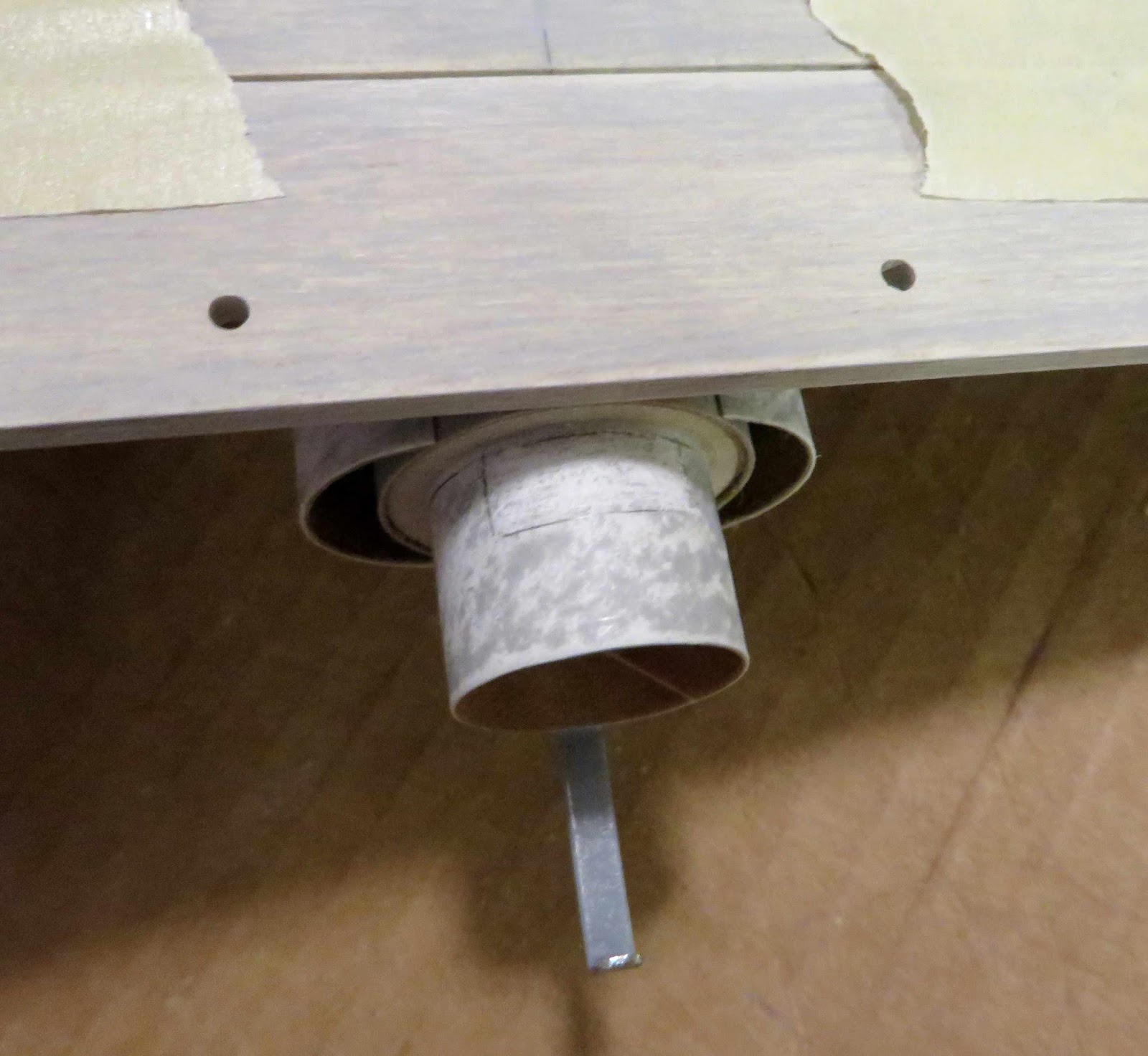
Mark with a pencil, remove the pop pod and glue the ring in place.


After the ring dries, slide the pod back into the main body.
Tape the elevator in place.
Set the elevator hold-down piece in place and trace around its location.
Scrap off any paint for a better glue bond.


Mentioned in an earlier post:
Don't sand down the curved bottom. I sanded the burnt wood off and the hold down piece ended up being too short.

The bottom was build up using two layers of 110 lb. card stock.

Wednesday, March 8, 2017

Estes Skydart II #3229 Build, Part 15, Lug Cut and Gluing

Cut a launch lug with a knife alone and you'll end up with a crooked and crushed end.
In the past I have cut launch lugs by sliding a dowel inside the straw for support. This is probably a better idea.

TIP: Mark the cut line all the way around the lug.
Turn and slide a Q-tip into the lug until the cotton tip is centered at the cut line. The cotton supports the lug wall during the cutting pressure.

I extended out the blade on my brake off knife. This allows me to roll the longer blade over the pencil cut line.
Go slow and make sure the blade is perpendicular to the lug.

Two lugs, both 1" long.
Sand the edges flat with a sanding block.


Notice how the lug sits under the wing.
To keep the glue from getting everywhere, apply a line of glue inside the two contact points shown in pencil.
The glued lugs were set in place using long tweezers. You'll have a difficult time getting the lugs into that tight corner without getting glue everywhere.

Check the alignment of the two lugs by sighting from the back. I found the rear lug can easily go out of alignment.


GOTCHA: Don't glue the nose cone in as shown on the bottom right of page four. You'll need to install the clay weight later on when balancing the model and finding the C/G. You'll find the C/G point (5" from the rear) hidden on the back of the smaller parts list page.

Tuesday, March 7, 2017

Estes Skydart II #3229 Build, Part 14, Ends and Edges


I added a fillet of Titebond M & TG to the front and rear of the wing.

I didn't do a fillet along the inside down the tube wing joint. I've learned from past experience that a deep fillet won't dry without plenty of bubbles.


The elastic holes in the rudder and elevator were rounded using a small diamond rat tail file.


Before applying any glue to the nacelle tube edges, do a dry fit.
Try to set them on the line without too much sliding around. Once glue is applied on the edges you'll want to place them without glue tracks all over the tube.

Monday, March 6, 2017

Estes Skydart II #3229 Build, Part 13, Gluing On The Wing


The center line of the wing was sanded for a stronger glue bond.

I wrapped some old 220 grit around a round pencil. The eraser end gave a good cushion for sanding.


The primer was scraped off the glue line.
A line of glue was ran down the body tube.
On the left side is the glue line formed using the "V" pinch of the fingers explained in an earlier post.

The wing and main body tube were set down on a flat countertop.
As the glue starts to set, go back and double check the alignment. A round body tube on this flat wing can slide around a bit.