Thursday, October 16, 2014

Art Applewhite MMX Bic Pen Rocket Build, Part 1, Parts

Here's a quick freebie. 
A high performance, MicroMaxx rocket made from a Bic pen.
Art Applewhite has designed some great saucers, spools and monocopters

First stop by:
http://www.artapplewhite.com/
Check out all the spools, saucers and monocopters
Look to the upper left, click on "Free Stuff"
Read the Limitation of Liability,
Click on "I Agree"
Go to the Free Stuff page - Click on "MicroMaxx Rockets"
Click on the "Bic StiC"


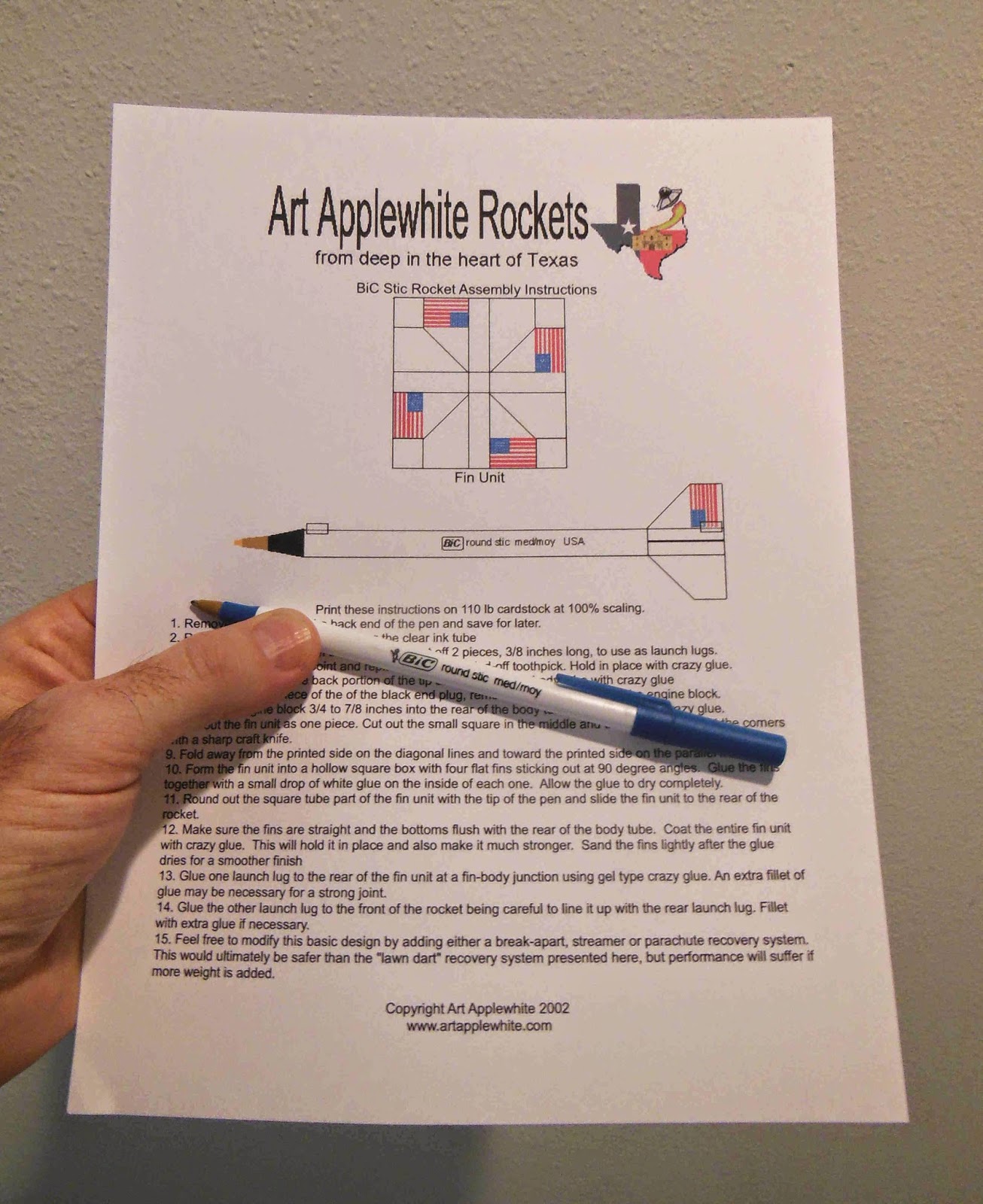
Print out the instructions (with fin can) on 110 lb. card stock.

You'll need a Bic StiC pen and hobby tools.
Add a 1/4" dowel if you want make an coupler, Kevlar and a streamer for recovery.

Moving a (Fresh) Decal?


One side of the U.S. ARMY decal on my Patriot model wasn't centered. I noticed this the day after the decal was placed.
You can't always get away with lifting and replacing a decal. This home print decal was set down the night before and hadn't been sealed yet.

The entire decal was wetted down.
The corner was carefully lifted with a knife blade tip.


Wet the underside and lift a little of the decal.
Repeat this down the entire decal length.
Don't let the decal fold under or onto itself.

Success will depend on the thickness of the clear coat and how strong the backing adhesive is. Don't try this on a decal that has set up over time.
The inset shows the decal reset and centered.
One more day and the decal edges will be sealed with Future acrylic.

Wednesday, October 15, 2014

Estes Teros Upscale, Finished


Even though the US AIR FORCE decals aren't in the original white, the upscale captures the feel of the Estes kit.
The model is BIG and could be a good match for the Estes E9 and E12.


There is some transparency in the white block over the orange paint. It's not as noticeable with the second black decal over the top.
Even with the outside edges of the fins trimmed back they still seem large!
The ramjet nose cone was a major design feature of the Estes kit. The champagne flute nose cone isn't exact but close enough to the original profile.

The Rocketry Show Podcasts

CG and Gheem have started rocketry podcasts available for download at:
www.therocketryshow.com

I listened to the second podcast and sent this email:

Hi  CG and Gheem,
 I enjoyed listening to the second podcast - keep 'em coming!
There were a few points that might need clarification.
These are not critiques, just suggestions for current and historical clarity.

  • Vern Estes approached Model Missiles about making engines for them. Model Missiles didn't approach Vern Estes.
  • Another great benefit to NAR membership is the NAR Member Guidebook. The 40% off coupons could almost pay for the NAR membership fees!
  • Semroc hasn't closed up shop - yet! They are still selling remaining parts and some kits. There are rumors the Semroc has been sold, but I'm waiting for an actual announcement.
  • When finding your C/G of a rocket, it's sometimes best to load the largest recommended engine. Then you can add nose weight if needed and (for example) be covered from an A engine through a C.
  • Centuri (Engineering) is pronounced "Centouree". Lee Piester liked the star name Alpha Centauri. He dropped the Alpha and the "A" from Centauri and got "Centuri".

Thanks again for the podcasts! You're off to a great start.
Chris Michielssen
www.modelrocketbuilding.blogspot.com

Tuesday, October 14, 2014

Estes Teros Upscale, Part 14, Decals

Set the horizontal bands on first, the U.S. AIR FORCE decals will center between these.

There was a paint ridge on the upper mask between the white and orange below. The clear border was cut off the bottom and the black edge set right on top of the paint ridge.
The decal could have been centered on top of and over the paint ridge. Setting the decal right on top of the ridge hides the raised paint lip.

The inset picture shows the band decals with the overlap seams in line with the launch lug. This hides the overlap when the model is on the launcher.

Enlarge the picture and look for the pencil marks at the lower right of the "R".
For centering, mark the center point on the body and the decal. It's easier to set the long decal down when the decal and body center points are already marked.


I made the mistake of leaving a hairline border around the fin center decals. This thin line had to be cut off.


White decal squares were set down and centered between the fins.
The black print decals were set on top.

TIP: Whenever you do a double layer decal, wait for the first decal to totally dry. Otherwise both layers will slip around on the surface.
Estes Altimeter Holes Part 2

Again - the Rotary Punch!
The holes will be somewhat hidden in the rectangular decals on the payload section.
While Estes recommends the holes be 2" down from the top of the body tube mine ended up at the end of the rotary punch reach, about 1 3/8" from the top.
The holes are still clear and not covered by the nose cone shoulder.

The Jolly Logic instructions say the holes should be as far forward as possible without being blocked by the nose cone.
This hole placement is a compromise between the two.


The decal edges were already sealed with Future acrylic applied with a Q-tip.
The punched holes got sealed again with some Future.

The inset shows the completed altimeter hole punches.


One last touch -
There was a bit of yellow paint showing at the top sides of the punch.
A permanent marker blackened just the top of the round punch.

Monday, October 13, 2014

Estes Altimeter Holes Part 1

Before punching holes in a body tube for the altimeter, I checked the instructions for three altimeters - The Estes Altimeter and the older and newer Jolly Logic One

Installation Tips:
Altimeter One (OLD)
“We advise that you punch at least three 1/16" to 1/8" diameter holes evenly spaced around the payload bay or the fuselage as close to the nosecone as possible, but low enough not to be blocked by the nosecone once it is inserted.”

Altimeter One (NEW)
“Add a few holes to allow air to escape at altitude.
The larger the airspace in your model, the larger the holes should be."

Estes Altimeter
". . . it is necessary to create 3 to 4 evenly spaced 1/8 inch square or round holes, approximately 2 inches below the open end of the body tube or payload section of your rocket. Cut holes using a hobby knife or 1/8 inch drill."

I knew I couldn't get three or four consistent square holes using an X-Acto knife. How many times has the knife cut farther than you would have liked when cutting a simple engine hook slit?
Cutting 1/8" squares would mean 12 or 16 small straight cuts! That's a ruined tube just waiting to happen.
I could spin the knife tip drilling a round hole. That works pretty well for smaller holes but when the diameter gets larger it's hard to keep the hole round. Drilling with a knife tip could chip the paint.
I'll just punch them.