Tuesday, April 21, 2020

Estes MRN Orbital Transport Laboratory Build, Part 15, Windows & Nose Trim


It's hard to see in the instructions picture, but the Gemini style capsule has a white circle disk on the nose and the hatch windows are white.

These would bee a tough mask. Hand painting white over black would take a few coats.


I needed something to trace around.
A 13mm "T" engine is just about the right size.

The engine casing was a close fit the to the curve of the  hatch window.
I traced around the engine casing onto the self-adhesive paper used on the previous Argus build.

The nose circle was cut inside the pencil line.
The hatch windows took a few tries - they ended up being a bit smaller than the 13mm casing.


Here's the finished capsule.
Considering the small size of the window stickers, they should stay in place.

Monday, April 20, 2020

Launch! Schoolyard Soccer Field, April 19, 2020

I have a hard time getting up a 6:45 a.m. (Considering I stayed up until 1:30 a.m.) I thought there was no wind, but at 100 feet up everything was drifting to the North.

Two MicroMaxx launches to kick things off,
A Semroc MMX BLUE BIRD ZERO and a Fliskits MMX CRAYON.
The Blue Bird Zero probably got to 50' with streamer deploy and soft landing. The FlisKits Crayon got great altitude, maybe 90'. That's pretty good considering the 1/2 second delay before ejection. I wish the MMX engines had 2 seconds delay -
To get ignition on both MMX engines I had to hold down the launch button for about three (long) seconds. Bare wire nichrome igniters take extra time in the little engines. 


The Estes MK-109 STINGRAY was next up with a Estes A8-3 to 250'.
This was a very sturdy model, thick tubing and a lot of plastic.
No damage on recovery.


I rarely launch the True Modeler's Nasa SCOUT. It's perfect for this field with an Estes B6-4.
It's tall with two reducers and very small triangular fins. One of the few LPR kits to include a rip-stop nylon parachute in black.
I would estimate the altitude at 300'.

Another rarely launched model - 
The Centuri VULCAN clone.
The eighth flight, I'm surprised this has lasted as long as it has. The home print card stock shroud body isn't as thick as the OOP Centuri kit provided.

A Estes B6-2 got the draggy body to an estimated 300'. An old, thin skin 12" Semroc chute brought it back with one dented intake.


While this one is finishing up on the blog:
The first launch of the Estes MRN ORBITAL TRANSPORT LABORATORY.

The instructions recommend A5-2, B4-2 and C6-3 engines. I used an Estes B6-4 with good success. I was a bit concerned about stability but it was fine. Estimated altitude was 325'.


I've mentioned in the blog build about the recessed, friction fit engine. The nozzle extends beyond the low end of the engine.

TIP: As suggested by Fred Schecter on the Forums - You'll find it easier to remove a friction fitted engine right after flight while it is still warm. You'd think the engine casing would expand, but the diameter actually decreases slightly after launch.


Another rarely launched bird, the 4th flight -
The Quest SPACE CLIPPER with an Estes C6-3. The 1994 Quest catalog says it'll reach 300' with that engine. CLICK HERE to see the catalog page.
It'd probably get much higher but there is a lot of drag and clay weight in the nose cone. There is so much weight in that nose, it comes down on a separate 12" parachute!
In past launch experience, I never got both chutes to open. The old Quest parachutes were crispy and could stay folded up at ejection. Today the nose cone chute opened, the body chute opened halfway. No damage when picked up. Always check to see if those landing leg pads are still glued on!

It's been cool in Florida, this morning things are warming up. Seven launches, seven recoveries with just a few dents in the card stock body of the Vulcan.

Sunday, April 19, 2020

Estes MRN Orbital Transport Laboratory Build, Part 14, Decals, Trim & Touch-ups


Here's how the decals were set, the USA was centered between two fins on opposite sides.

The available decal sheet has black horizontal stripes. While they could work fine, I used something different.


I pulled out my sheet of Contact Paper, Blackboard Material.

Strips were cut, wrapped and trimmed on the top and bottom of the American flag decals.


A little of the body tube edge was showing up between the black nose cone and black trim strip.

On the left is the before, the right picture is after the touch-up.


Some black marker was run around the tube edge hiding the white paint line.
One of my home print decal transfers ended up spotty. You can see some white showing through on the red square.

This doesn't always work - but I did some touch-ups with a red permanent marker. I lucked out this time and didn't have to print and use up another decal sheet.

Saturday, April 18, 2020

Estes MRN Orbital Transport Laboratory Build, Part 13, Chrome Trim & Fin Gluing

The old MRN black and white picture showed the black end color  as black. The 1973 Estes catalog showed the OTL in color. I could now see it wasn't black, but reflective chrome.
Why apply the chrome wrap before gluing on the fins? It would be very difficult to apply the wrap with the fin dowels in the way.
A 1" wide piece of Monokote Chrome Trim was wrapped around the tube. A notch was cut to fit around the launch lug.

After the wrap was stuck down I pressed the chrome with a fingertip to find the punched holes. A pencil was pressed into the holes to better see the locations.

Small "X" cuts were made with the tip of an X-Acto knife. You probably couldn't punch through with a pencil tip. I didn't remove the circle, I figured the folded in corners of the chrome layer would make for a tighter fit of the dowel ends.

The fins were pressed in place with no glue.
The contact point at the bottom of the ring was marked and the paint chipped off at the glue point.

The picture on the right shows a small square of paint scored and lifted off.
A "ball" of white glue was set on the dowel end. A small amount of glue was also set on the corner of the fin to contact the rear ring.

The idea is some of the glue would be pushed out along the dowel and make a fillet bead on the outside of the body tube. There is still glue on the dowel tip going into the drilled centering ring holes. White glue is used here, it could be seen outside the finished model and will dry clear.


Here's all four fins glued in place, ready for the home printed decals.

Friday, April 17, 2020

Estes MRN Orbital Transport Laboratory Build, Part 12, Paint & Fin Fitting


After a shot of filler/primer the body was slightly sanded.
Gloss white followed.

I noticed the exposed edge of the black centering ring didn't take the paint evenly. I added glue fillet over the black and shot the white again. This time the white covered evenly.

OOPS!
Eventually - it happens to all of us. Even with adequate drying time (48 hours) I had some wrinkling of the paint to the side of the launch lug!

I let it dry for a day and sanded it smooth with 400 grit. Waited two more days after that and shot the paint again. This time it was fine.
On to the decals and trim!


The fins were also shot with gloss white. I had to punch holes in the edge of some scrap cardboard to push the dowels in. This allowed me to spray gloss white on all sides.
The end of the dowel was left clean for gluing into the interior holes.


Here's how the fins should fit with the rear contact on the exposed ring edge. In a later post I'll show how the glue points are opened up for best adhesion.


To make an easier fit in the centering ring drilled holes, the ends of the dowels were tapered.

The fins were fitted in order from the launch lug going around the tube. The marks I, II, III, IIII helped me keep track of the individual fitted fin positions.

Thursday, April 16, 2020

Estes MRN Orbital Transport Laboratory Build, Part 11, Engine Mount Gluing


The motor mount assembly is glued so the lower 20/60 ring is flush with the end of the body tube.

On the left is the rounded dowel used to apply a glue drop to the inside edge of the top centering ring/body tube joint.
The other side of the dowel has a Q-tip taped on to smooth out the glue that was set into the joint.


Here's the inside just after the glue was smoothed with the Q-tip. Perspective of the picture makes it look deeper than it really is.
With the engine mount in, the lower single ply Engine Mount Cap shroud is glued and slid in place. The black edge of the exposed black centering ring is where the lower fin tip is glued.

The double nested nozzle is glued over the exposed engine mount tube and against the lower Engine Mount Cap shroud.

TIP: Line up both of the nozzle tab seams on a fin line to visually hide them on the finished model.


Before spraying with a white undercoat, the 2 3/8" long, 1/8" diameter launch lug is glued on. Paint was scraped off for better glue adhesion.

Wednesday, April 15, 2020

Estes MRN Orbital Transport Laboratory Build, Part 10, Dowel Hole Positioning


Holes were punched and enlarged slightly for a tight fit of the dowels.

TIP: You can clean up the burr left from the punch with a sharpened dowel. Rotate the tip in the hole to dress the edges.


Here's how the fins ended up -
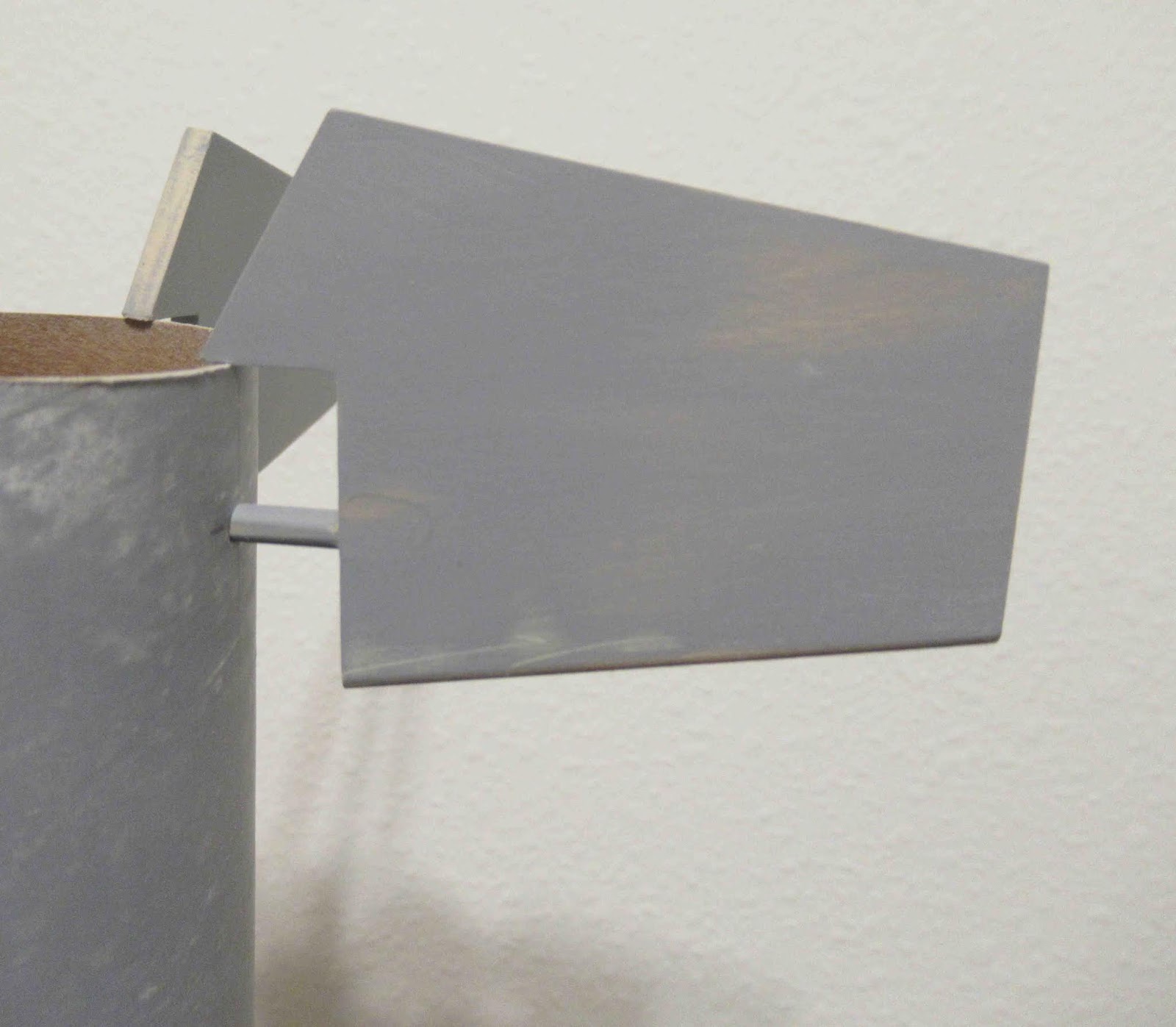
You can see how the "fin holder" tip overhangs the inside edge of the main tube.
The corner tips will be glued onto the lowest 20/60 engine mount centering ring.
Notice the hole drilled in the 20/50 ring for the fin dowel to be glued into. The picture on the left is the "after" shot to show what you are going for.

Lines are drawn down the motor mount tube to help line everything up when the mount is slid into the glue ring.
I used the rat tail file to line everything up then the pencil lines were drawn.


Pressing and turning the file tip made small divots (pilot holes) in the centering ring.
A 1/8" drill was spun by hand into the centering rings but not into the BT-20 motor mount tube.