Showing posts with label History. Show all posts

Friday, October 11, 2024

Estes Star Stryker Build, #3206, Part 3, Engine Hook & Engine Mount


I don't like finger tabs on engine hooks. 

Score it with a wire cutter, then bend back and forth until it breaks off. File off any rough edges.


Flip over with the cut end up.

I made a bent a slight curve into the engine hook.
The extra tension makes for a better hold of the engine. 


Some history:
The top picture is from the Estes instructions.
Notice the engine tube is 3" long, the hook extends 1/4" over the low end.
A couple joins the engine tube to the longer upper tube. The coupler also serves as the engine block.


This design was first used in some minimum diameter Centuri kits. This instruction illustration is from the Scram Jet.

Gluing an engine block in the correct position (by sliding it into some glue in the tube) has always been iffy, especially for first time builders. Gluing a coupler in a shorter tube from the top does two things. It easily places the engine block in the correct position. The longer engine block works as a coupler joining the two tube lengths.

Wednesday, April 24, 2024

Old Estes Parts, Part 2

Here's that same BT-30 (from a post a few day's back) with a nose cone a fin unit.


The plastic fin unit was re-purposed from those used in fireworks. 
The fit over the end of the BT-30 tube is very good.
The fin unit and nose cone are listed in the 1960 Estes catalog. The fins used in the Sky Bird and Dirty Bird designs.
An illustration for both parts is in the second 1961 catalog: CLICK HERE


The nose cone shoulder slips over the body tube edge. This is another fireworks piece.
These plastic parts were phased out as balsa equivalents replaced them. The manufacturer's probably didn't want to associate with any ties to fireworks.
Thanks again to Lonnie Buchanon for lending me these parts.

Monday, April 22, 2024

Old Estes Parts, Part 1

Lonnie Buchanon let me borrow some old Estes parts he found in a Craig's List buy.
Below is a BT-30 tube.

Mark II wrote in YORF:
https://www.rocketshoppe.com/info/Estes_Body_Tube_List_3.1.pdf
"BT-30 is a recreation of the very first body tubes that the fledgling Estes Industries sold in 1960. Yes, these were the legendary tubes that Gleda Estes hand-rolled from mimeograph stencil backing using a slotted aluminum mandrel. BT-30 was used in most of the early Estes Industries kits, including the Scout, Mark, Space Plane, Sky Hook and Sprite (K-1, -2, -3, -8 and -15). The somewhat loose fit of their 18mm motors in it is what makes the tumble recovery-inducing weight shift easier and more controllable in the Scout and Sprite. Other kits that used it were the TK-4 Hornet Mini Brute, the Scout II and Scout III, the Mark II and a number of MRN plans. There is an extended discussion of this tube in John Brohm's Estes Body Tube/Kit Reference v3.1." CLICK HERE
  

I don't think this is a Gleda Estes rolled tube but a manufactured recreation as mentioned above.
Estes probably had BT-30 tubes made for them when the kit demand got too high to hand roll the tubes.
This one is rolled very tight and clean, I would assume the hand rolled tubes weren't as taut. I can't say for sure as I've never seen a Gleda Estes hand rolled tube in person.
 

This shows the fit of a current engine slid into the BT-30 tube. There is plenty of space for a few tape wraps to get a good friction fit.
The loose fit reminds me of the old Model Missiles instructions that mention you could use rubber bands wrapped around the motor for a friction fit.

Sunday, April 21, 2024

Old Letter

I'm cleaning out the garage, getting rid of old things I haven't looked at in years. In a file cabinet, I found this letter from Bob Bruce. I met and hung out with Bob at the 1975 NARAM 17 in Orlando, FL.

Bob always seemed to place in the Estes design contests, some of his ideas were groundbreaking. He started his own rocketry company called California Model Rockets. Back when a model rocket had to weigh under one pound, he sold models named "Woppers". They were big for their time, 4" diameter rockets with foam centering rings and cardstock wrapped bodies.
 

Here's the interesting part of the 1976 letter - for all the Star Wars fans:


The original title of Star Wars was "War Star". Bob told me that many of the spaceship detail pieces were plastic parts from AMT car model kits - Muffler pipes, axles and the like.
I understand Bob (Brandy) passed away in 2019.

Thursday, April 18, 2024

The Mystery Fin

Last November, my Sister finally brought my comic books from California. When I was going through the books, I came across this fin.
It looks to be 1/32" plywood. It is airfoiled. I think it came off a Streamer Duration model I flew at NARAM 17.

If you are curious, the comics were from the mid to late 1960s. 
The box of comics sold for $700!

Friday, January 12, 2024

Old Estes Postcards


If you were a Rocketeer in the late 1960s and early 1970s, you'll recognize these postcards.
In the barn at my Grandparents ranch, my Sister found a large metal drum full of my old comic books. These postcards were in with the comics.
In total, I counted 39 postcards. Five or more of each, only one of the Estes building.


I had entered the Design Of The Month a few times. Some cards were personalized. In addition to this postcard, I did get other letter correspondence from Avona O'Leary. She must have been responsible for all the last names that started with a "M".

I thought I had a real Bill Simon autograph. I had three of these. After comparing the signatures, I could see they were printed.

Sometimes a postcard was included with an order. You could also send a note and ask for a complete set. I must have done that a few times.

Thursday, February 2, 2023

Centuri Quasar, Kit #KC-7, Background

The Quasar was introduced in the 1971 Centuri catalog.
A "Classic Space Ship Design!"
My Mother liked this one, she said: "It reminds me of the old Buck Rogers rocket."

The fin pod tubes had vacu-form ram-jet tops and bottom nozzle inserts. The same pieces were used in the Centuri SST Shuttle-1 kit. 
I won't be using vacu-formed or molded resin parts. I know Sirius Rocketry has them available, that'd be an easier way to go. I'll be assembling them from pieces and parts - old school. This build will be a "close" clone.

The first catalog colors were an overall white with two red fins. Later, Centuri recommended painting the body silver. I'll be home printing decals so the main body will be white. Home print decals are somewhat translucent, the red decals don't look very good when set over silver paint.


The Centuri "punched plate" style baffle was new and included in the Quasar, Centurion and Long Tom kits.

The more complex Estes "Ducted Ejection" (forward, back, forward) baffle was included in the new Bandit model first shown in the 1972 catalog.


From the NAR Facebook page, 
Glen Swanson posted a possible design influence:

"A conceptual drawing of an air-breathing boost vehicle. Turbojet engines are located in the body of the vehicle and the three pods. The first stage may be detached, as shown in the upper portion of the illustration, landed and used again. GE Electric, 1960."


I have to wonder if the Centuri Quasar inspired the more recent Estes Protostar. 
The fins have similar curved leading and trailing edges. The Quasar ramjet tube style engine pods have been replaced with three Alien Invader nose cones.

Monday, January 30, 2023

Old Vashon Commercial

An old Vashon (Pre-Estes) commercial ad I found on YouTube:


To see the video: CLICK HERE
The picture above shows an engine/propellant/timer disk test. Vashon Rockets used Freon, a self refrigerant. You could hold onto the filled rocket body and pull the nozzle plug. The aluminum rocket body would get cold as the compressed gas was expelled. 

Tuesday, June 14, 2022

Original Estes Mars Snooper


Here's the first catalog appearance of the Mars Snooper from the 1966 Estes catalog. To see this page - CLICK HERE. 
The kit was first 
available in 1965. 
Launch it with a 1/2A engine? I don't think so - 


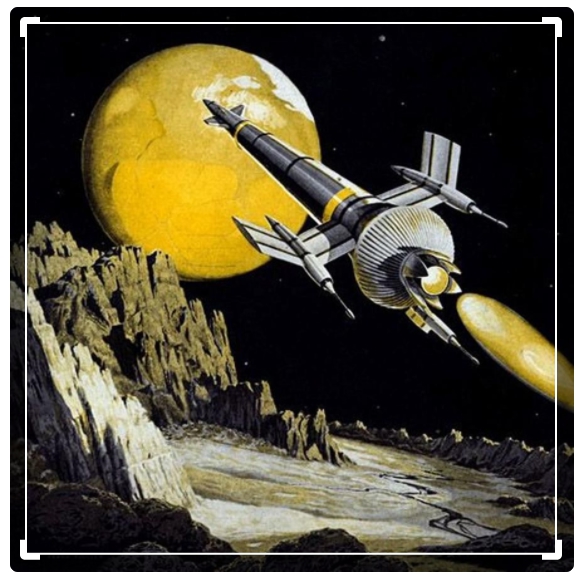
Inspiration for the design first appeared in an ad advertisement for American Bosch Arma Corporation, 1959. Art by Frank Tinsley.
"Mars Snooper. Mars can be seen in the background as a reconnaissance craft prepares to land on the surface of red planet's moon, Deimos." 


The Snooper kit design goes back to 1964.
It was originally a Estes "Rocket Plan #25.
To see the plans, CLICK HERE

Check out the fin pods, back then made by shaping balsa.
The three part shroud assembly is different, the low shroud is shorter in length.

The smaller upper fins have changed over the years - sometimes rounded off, other times with squared corners.

Sunday, June 5, 2022

How Do Some Kits Get Their Names?

From the Estes Model Rockets Facebook page,
Robert Spillane posted: 
"Got some good conditions so the SPEV's and the Pathfinder are getting the dust flown off. Keeping it low(500'-ish) with that slight west wind." 
John Boren (Estes Designer) responded:
"I designed three of those models. The Slotted Tube Model in 2012, Excess Parts Model 2010 and the John Boren Rocket 2013. You ever wonder how some rockets get their names, now you do.

From left to right - 
Estes STM-012  (Slotted Tube Model from 2012)
EPM-010 (Extra Parts Model from 2010)
JBR-013 (John Boren Rocket from 2013)
Pathfinder (Not named from abbreviated words, 1998 - 1990)

On Facebook, Kirk Groeneveld asked: 
"Just bought a rocket kit called "ESAM-58". Can anyone tell me why it's called this, or what it means?
A reply from Vin Sauriol: "Estes Surface to Air Missile, design #58
John Scott Bryan added: Estes designer John Boren was born in 1958


The newer hobbyists may not know - 
The original Estes S.P.E.V. (shown above, #K-59, from 1972) was said to be a Spare Parts Elimination Vehicle. 
As the story goes, the Estes warehouse had too many extra Thor Agena B parts.
The kit face card called it a SPace Exploration Vehicle.
There's some Saturn V influence here.

Check out the S.P.E.V. instructions at Jim Z's: CLICK HERE

Compare the profile of the Thor Agena B kit next to the upper portion of the SPEV kit..
The lowest BT-70H tube of the S.P.E.V. was the same length as the main body ot the Estes Little Joe II.

Friday, June 3, 2022

Before Estes & Centuri - Jetex!

On the Facebook, Estes Model Rocket page - 
Bob Cassova reminded me of the old Jetex engines. This one is the smaller "50" style, the same engine I used. Jetex also made a larger 150 engine.


That small pin hole is the nozzle! It wasn't very efficient.
Jetex also had a line of balsa and tissue airplanes that used these engines to help them reach apogee before gliding back.
1. You'd open the case - that thick wire is held in the nozzle side and snaps on over the rear of the main body. Snap off the wire and connected nozzle cap.
2. Reddish brown pellet slugs are slid in the main body.
3. Feed the Jetex fuse through the small noz-hole. Coil the fuse so the loop lays against the top of the propellant pellets.
4. Snap the wire and nozzle onto the main body housing.


I made a car out of a tin plate with four wheels taped to the bottom. The Jetex engine was screwed into the top of the metal plate body with the engine facing out the back.
It performed a little like the Estes Land Rocket cars but had no guidance line to run it in a straight line. You'd light the fuse, run away then turn around in enough time to see it roll 75' down the street.

My mistake - 
I bent up flaps on the backside of the car hoping for a "wheelie". The flaps got it airborne! It flew about 8 feet up and seemed to hover. Not very stable. My interest in the Jetex engines quickly subsided.
Luckily I saw an Estes catalog soon after.

For more background, check out the Wikipedia page: CLICK HERE

Sunday, April 3, 2022

Estes EAC Firecat #0821, Build, Background

The Firecat was an interesting design, the parts and decals certainly looked familiar.

It was the second design available only to members of the Estes Aerospace Club. The first EAC kit came with your membership kit - the EAC Viper.

The Firecat was introduced June 1974 in the first issue of the EAC Spectra newsletter for $2.75.

Last advertised in the July/August 1975 Spectra.
“Offer good only with EAC order form
Offer expires 12/1/75 or when supply is exhausted.
Hurry! Supplies are limited.”
This one has an interesting back story.
The Firecat was a redesign "kitbash" made up from parts from the discontinued Estes/Vashon Honest John.
Freon was outlawed because it depleted the Earth's ozone layer. The Vashon Cold Power line was cut - Estes was stuck with some parts inventory.

By 1975 some Freon powered rockets were eventually redesigned  into "Cold Power Convertibles". You could fly them with the Vashon Freon engine or use the 20/50 standard engine mount and launch with 18mm standard motors. These three kits were Shark, Marauder and Yankee 5. (I don't know why it was named the Yankee "5". If it had five fins, maybe. The rocket only had four fins.)
I built and launched the cold power Shark rocket. 

When fueled, the tank pressure swelled out small rubber gaskets (note the small black dots in the engine in the lower right of the picture) This held down the compressed spring and BT-48 tube until it was released at apogee. 
The launch button housing was connected to a metal cable that released the fueling adapter inside the nozzle.

To see the Shark instructions: CLICK HERE
Instructions provided by Leo Nutz 

One thing I hated about the design - When the rocket was on the shelf, that spring was always extended looking like a cliché broken toy. 
This smaller Freon motor performance was like a B6-4. If the outside temperature was cold, Freon performance was poor. I eventually added the 20/50 adapter to the Shark for the black powder conversion.
The Firecat build starts tomorrow!

Saturday, March 19, 2022

Use Only Centuri Engines?


Dannymrmissle scored a mint, bagged Centuri BATROCK kit 
and posted this picture on YORF.

Notice the bag topper line: "USE Centuri safety approved rocket engines ONLY with this rocket kit."
Why would it make a difference?

Most never knew that Estes made the engines for Centuri until the early 1970s. Here's an picture from the 1969 Centuri catalog:

Early on, I remember thinking: "These Centuri engines sure look a lot like the engines I get from Estes."


Then, the Centuri Phoenix made engines appeared in the 1970 catalog -
Those new rolled on graphics were slick!
We'd still find the older Penrose made engines with the Centuri name on them for a few years until the older stock was depleted.

Friday, January 28, 2022

Senchuree or Centouree?


Here's a Facebook post answering the question: "how do you pronounce Estes?
Enlarge to read the copy - 

I added a link to my blog post about how to pronounce Centuri, another name many don't pronounce correctly.

Here's the link explaining how I knew: CLICK HERE 


Notice the "Thumbs Up" I got after my response.
I got an approval from Rick Piester, son of Lee Piester, the founder of Centuri Engineering. 

That customer approval from the 1972 catalog was a little bias - one way to get your kid in print!

Friday, September 10, 2021

Estes Super Mars Snooper #7309, Build, Background

From the Estes Website:"
The Mars Snooper was originally released in 1965 and earned the cover of the first ever, full color Estes Catalogue in 1966! Now this beloved classic has received a rework, and is available again! We stayed true to the original in every way that matters. It is an expert build, as was the original. It’s large, like the original, and we made it even a little larger. The sleek and futuristic design was ahead of its time in 1966, even the concept of a nuclear-powered rocket was novel and barely discussed – we made sure to stay true to that. A nuclear powered rocket would be able to remain in space for years, maybe decades, but in 1966 a nuclear powered rocket was merely an exercise in fantasy. Today these technologies are being proven and developed. With this rocket, Estes looked to the future and dreamed of the rocket technology the world would see as the decades went on. It was envisioned as a research vessel, an unmanned probe that would do exhaustive research on one of moons of mars, Diemos. The model stands well over 2 feet tall, and it flies to 400 feet on a C11-3."

To see a blog post about the original design construction, CLICK HERE

That's me, getting a Mars Snooper ready for launch in the early 1970s. You'd think I would comb my hair for a picture. (I did have hair back then.)
I don't know why I picked those colors for the Snooper, blues and purples. Not my best choice.

My mother took this picture. We would drive onto our family ranch property and find an area that didn't have much growing on it. Those are Brussel Sprouts in the background. Today strawberries take up the bulk of 175 acres.

Interesting Rocketry Story about my Grandparent's ranch - 
In 1969 California, you couldn't easily purchase model rocket engines. Your flying field had to be approved by a representative from the State Fire Marshall's office.
My Mother made a few calls to Sacramento (the state capitol) and got ahold of the Fire Marshall office. They agreed to send someone down to check out the proposed flying field.
As it turned out - the Asst. State fire Marshall, a Mr. Mullin approved the Ranch and gave us a permit. 
At first we didn't notice - it was an "all encompassing" permit to launch, buy and sell engines! I could have opened up a hobby store and sold rockets and engines.
At NARAM 60 I told this story to Dane Boles. He seemed surprised. He said there was only two of those permits issued in California, mine and his! Dane worked with West Covina Recreation heading up the Model Rocketry Education Department before being hired by Estes Industries.
The actual kit build starts tomorrow . . . 

Saturday, June 12, 2021

Old (Original) Mars Snooper Instructions

With the upcoming Super Mars Snooper kit from Estes - you might find this interesting. 
When Estes releases the kit, a build will follow on the blog.

On the Estes Model Rocket Facebook page - 
Mark DiGregorio wrote: 
"When I first got into rockets at 10 years old there were no laser cut fins, you would have to cut a pattern from a piece of balsa sheet! I also remember building escape towers with one piece of dowel glued together on a template in the directions, had to make the spike by hand! Also had to cut chute out and put lines on with a sticker, things have gotten a lot easier since 1966!"

This prompted many responses, one from Mike Meyer:
"When I got into Rockets we had to harvest the balsa wood . . ."

James Zelewski (Jim Z's Plans) proved them right with a link to the original Estes Mars Snooper instructions.
Before it was a kit, The Mars Snooper was just an instruction sheet, Estes Industries Rocket Plan #25. To see the entire file: CLICK HERE 
      

The fin pods in the kit were first cut and formed from a balsa nose cone stock.

Simply cut the block into quarters,


Rough carve,


and sand round. Easy, peezy!


Glue onto outside edges of the two main fin pieces.

Check out the shock cord mount!


Make your own coupler, cut slits and weave the shock cord through the cuts. 


" . . . you may use the standard shock cord mounting procedure familiar to most every model rocketeer"


Glue the mount into the top end being sure to recess it 5/8" for the adapter shoulder. Sheesh!

Thursday, February 18, 2021

Old Altitude Claims?

Lets take the Centuri Screaming Eagle as an example:
From it's introduction in the 1973 catalog, Centuri claimed "Out of sight with a C". From 1974 through 1978, the Screaming Eagle could reach 1,500 feet. From 1979 on it lost 300' altitude, down to 1,200 feet.

Here's even more altitude estimations from the Screaming Eagle kit instruction sheet:

On the same rocket, altitudes predictions changed over time. There wasn't much consistency.


I remember seeing my first Estes catalog and thinking: "A 50 cent rocket can get to 2,000 feet?"

How could they know? There were no small altimeters then. And who could or would challenge the claims?
They probably "guess-timated" using the Altitude Prediction Charts, the old Estes TR-10.

Sunday, February 14, 2021

So You Wanna' Be A Collector?

On YORF,
Scott H. posted a link to an updated list showing production dates for all the Estes kits. 
Thanks go to Don Altschwager for all the updates.
To see the Estes list: CLICK HERE

Check out which kits are recently discontinued by the "Last Avail" 2020 listing.

Friday, February 5, 2021

More Vashon Jet Glider Comparisons

 Some rocket nerd research - 
It didn't occur to me to look at the older Vashon catalogs at the Ninfinger website: CLICK HERE
This catalog looked to be from the early 1970s. The Vashon line was first sold through the Estes catalog in 1972.

The SHRIKE has a blunt nose and intakes at the front of the wings. The vertical stabs are a triangle shape.


On the right: The old catalog XS-1 Space Shuttle has a longer point nose and no intakes.
The wings look more swept and the vertical stabilizers are a trapezoidal shape. The front of the stabs don't extend beyond the leading edge of the wing.


On the left: Here's the Ebay XS-1 picture from the post a few days ago. 
It has the same blunt nose of the Shrike, intakes and triangular stabilizers.
Estes may have ran out of the XS-1 bodies (they are very similar) and figured: "Who'd know the difference?" 
Do different stickers really make a different model?

Thursday, February 4, 2021

Comparing the Vashon Jet Powered Planes

Vashon Model Rockets have always held a special place for  me. In 1969 they were the only rockets we could launch in California. The state's black powder fireworks regulations were strict!
 
On YORF, Rraeford asked about the Vashon (Estes) Shrike and XS-1 "Jet Powered Planes".
Both of these Ebay listings are shrink wrapped and have never been opened.

To me they seem overpriced, the Shrike at $155.00 with free shipping.
The XS-1 is at $250.00 with $56.75 shipping!
I mail a lot of finished model rockets and have never seen  shipping charges that high!


Apparently, 
These two differently named and packaged models were from the same Styrofoam mold. The only difference seems to be the sticker sheet. 
Unless, there were originally two different shapes and Estes switched over to one design with different packaging.

Some décor was already applied at the factory. That cockpit sticker on the XS-1 is crooked!
 
I did a post on these a few years back, but didn't have package pictures for comparison. The nose of the XS-1 looks longer, but the rounded black area is a cut out in the cardboard to hold and center the nose of the glider.
The Estes catalog art somewhat shows they could be the same shape. To see that post and Estes catalog page link: CLICK HERE